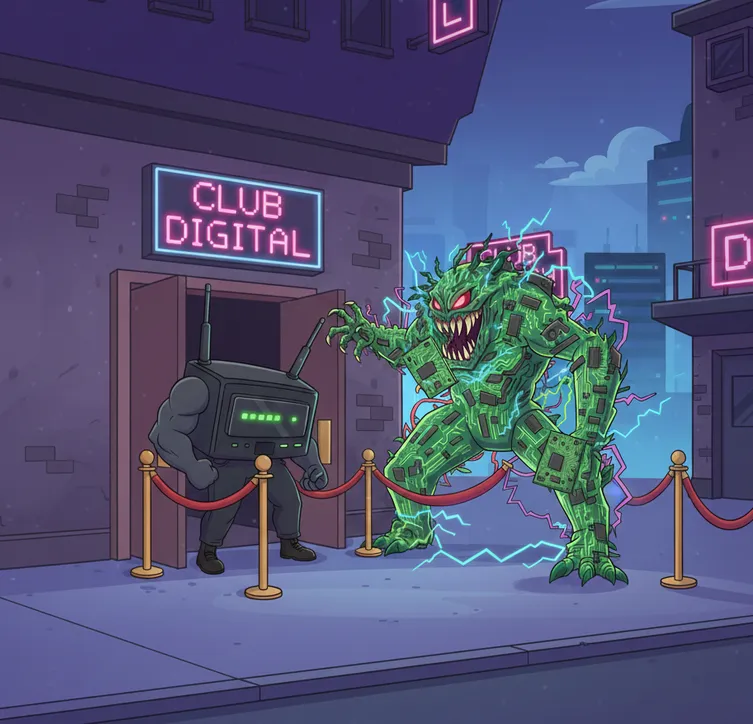
The Next Generation Bouncer
Your Internet Security Is Stuck in the 90s (And your Firewall is basically an ignorant Bouncer)
Let’s travel back to the 1990s. Life was simpler. We had Tamagotchis, and "Traditional Firewalls." Back then, a firewall was like an ignorant bouncer at a club who only checked two things in order to let you in: 1) Is your name on the list? and 2) Are you wearing a hoodie?
If your name was "Web Traffic" and you were not wearing a hoodie (blocked ports), the bouncer lets you in. He didn't care if you were carrying a suspicious, ticking briefcase or if you were actually a donkey in a long coat. He just checked your name and nodded you through.
Fast forward to today. The internet is no longer a localized dance club; it’s a chaotic, 24/7 global carnival where the "bad guys" have traded their crowbars for invisibility cloaks and PhDs in psychology. This is why you need a Next-Generation Firewall (NGFW).
Why the "Old Bouncer" Doesn't Cut It Anymore
Traditional firewalls look at the "header" of data—basically the return address on an envelope. If the address looks okay, it goes through.
But modern cyber-threats are sneaky. They hide inside "approved" envelopes. They look like a harmless PDF from "Accounting," but inside, they’re a digital termite infestation ready to eat your data. The old bouncer? He’s still just looking at the return address and the hoodie. He’s blissfully unaware that your network is currently being looted.
Enter the NGFW: The Secret Service Agent of the Internet
A Next-Generation Firewall isn't just a bouncer; it’s a full-on forensic team, an X-ray technician, and a mind reader rolled into one. Here’s why it’s the upgrade you didn't know you needed:
Deep Packet Inspection (DPI): Instead of just looking at the envelope, the NGFW opens it, reads the letter, checks for poison powder, and ensures the "Accounting" department actually sent it.
Application Awareness: It knows the difference between "I’m using Facebook for work" and "I’m using a sketchy app that looks like Facebook but is actually stealing my passwords." It can tell the difference between a Zoom call and a file transfer meant to exfiltrate your secret chakalaka recipe.
Intrusion Prevention (IPS): It doesn't just wait for a known "bad guy" to show up. It watches for suspicious behavior. If someone starts trying to open 1000 door handles in a row, the NGFW tackles them before they find one that’s unlocked.
Sandboxing: If a file looks "maybe" dangerous, the NGFW puts it in a digital "time-out room" (a sandbox) to see if it explodes. If it does, no harm done to your actual network.
Using a traditional firewall today is like protecting your house with a "No Trespassing" sign and hoping for the best. An NGFW is like having a gated community, a ring camera, a german shepherd, and a laser-grid security system.
Sure, it sounds fancy, but in a world where "123456" is still a top-ten password, we need all the help we can get.
There you have it, it's not 1991 any more - make sure to get your internet connection protected by a Next-Generation Firewall!
