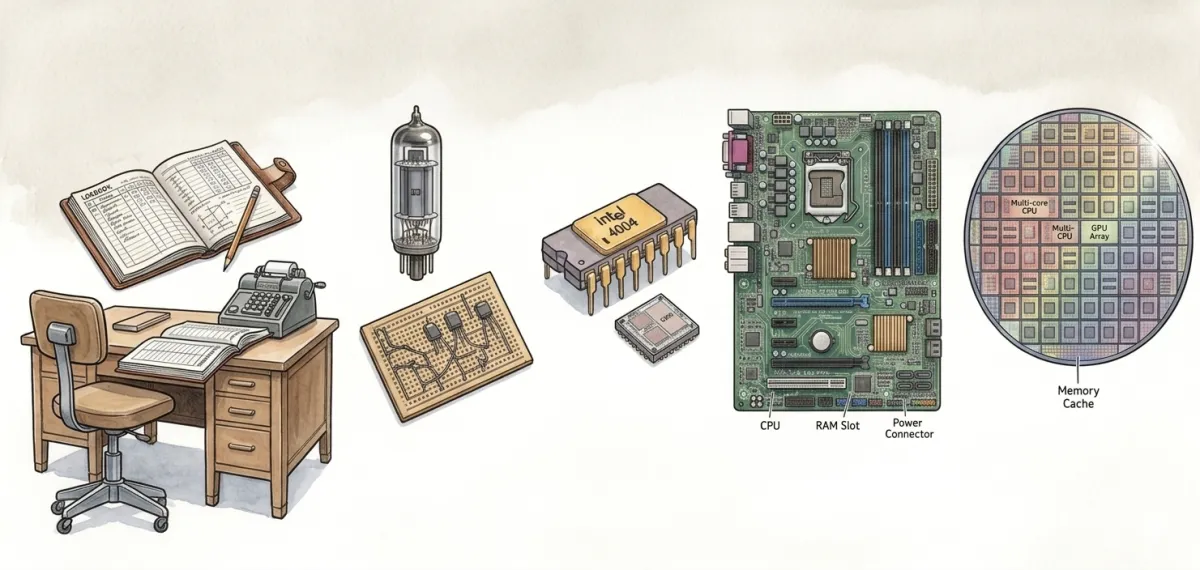
From Human Hearts to Silicon Souls: The Epic Evolution of the Computer
From Human Hearts to Silicon Souls: The Epic Evolution of the Computer
When you hear the word "computer," you probably think of the glowing screen in your hand or the laptop on your desk. But for most of human history, a "computer" wasn't a machine at all. It was a person.
Buckle up, because the story of how we went from counting on our fingers to chatting with Artificial Intelligence is one of the wildest rides in human history.
When "Computer" Was a Job Title
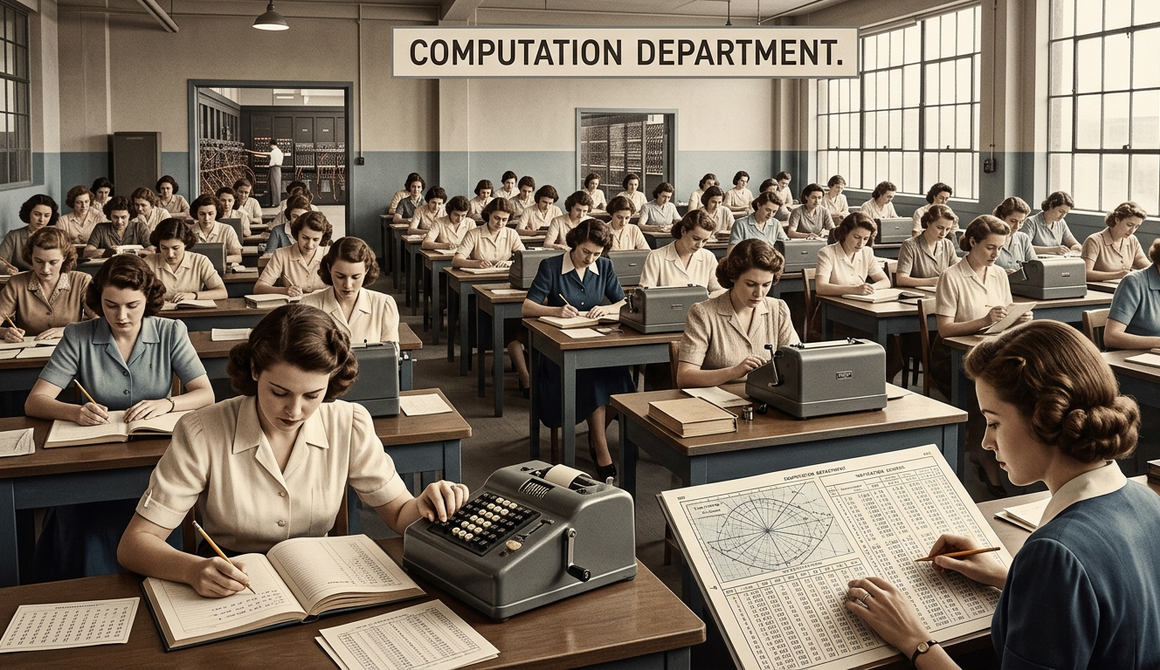
Before the 1940s, if you were a "computer," your desk didn't have a monitor—it had stacks of paper and a very sharp pencil.
For centuries, human computers (many of whom were brilliant women) performed the grueling mathematical labor required for navigation, astronomy, and later, wartime ballistics. They were the original "processing units," sitting in large rooms and solving complex equations by hand to map the stars or calculate the trajectory of a literal cannonball.
It was slow, it was exhausting, and—as humans often are—it was prone to typos. The world needed something that didn't get tired or make "human errors."
The Birth of the Iron Giants
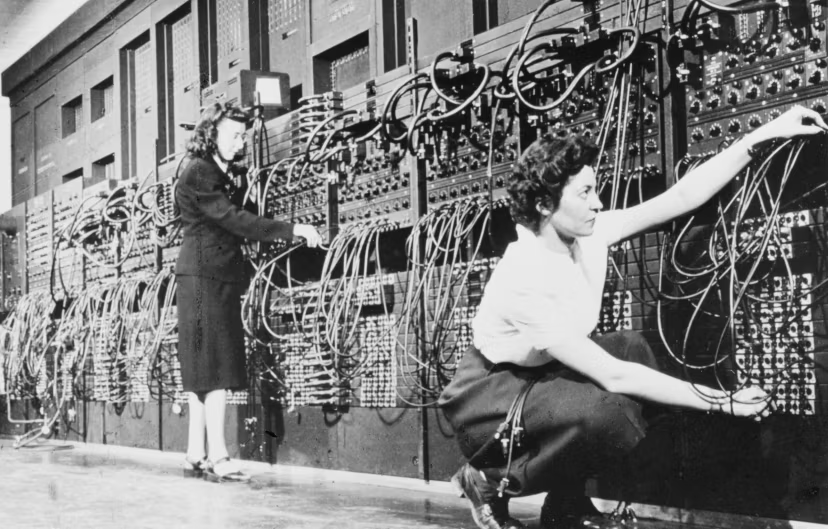
The "Modern Age" of computing kicked off during World War II. Machines like ENIAC were the first true electronic general-purpose computers.
But these weren't sleek devices. ENIAC weighed 30 tons and took up an entire room. It didn't have a mouse or a keyboard; scientists had to physically flip switches and plug in cables to "program" it.
The ENIAC didn't use modern chips; it used over 17,000 vacuum tubes. These were like large, hot light bulbs that controlled the flow of electricity. They broke constantly, meaning engineers spent more time replacing "burnt-out" parts than actual computing. The logic was simple, and the memory was nearly nonexistent. This was the "Transistor Logic" era, where scientists manually built the connections between massive, hot components.
The Big Breakthrough: In the 1950s and 60s, the invention of the tiny, cool-running transistor changed everything. It allowed us to shrink those room-sized giants into boxes that could fit on a desk. By the 1980s, the "Personal Computer" (PC) was born, bringing the power of a NASA lab into the average teenager's bedroom.
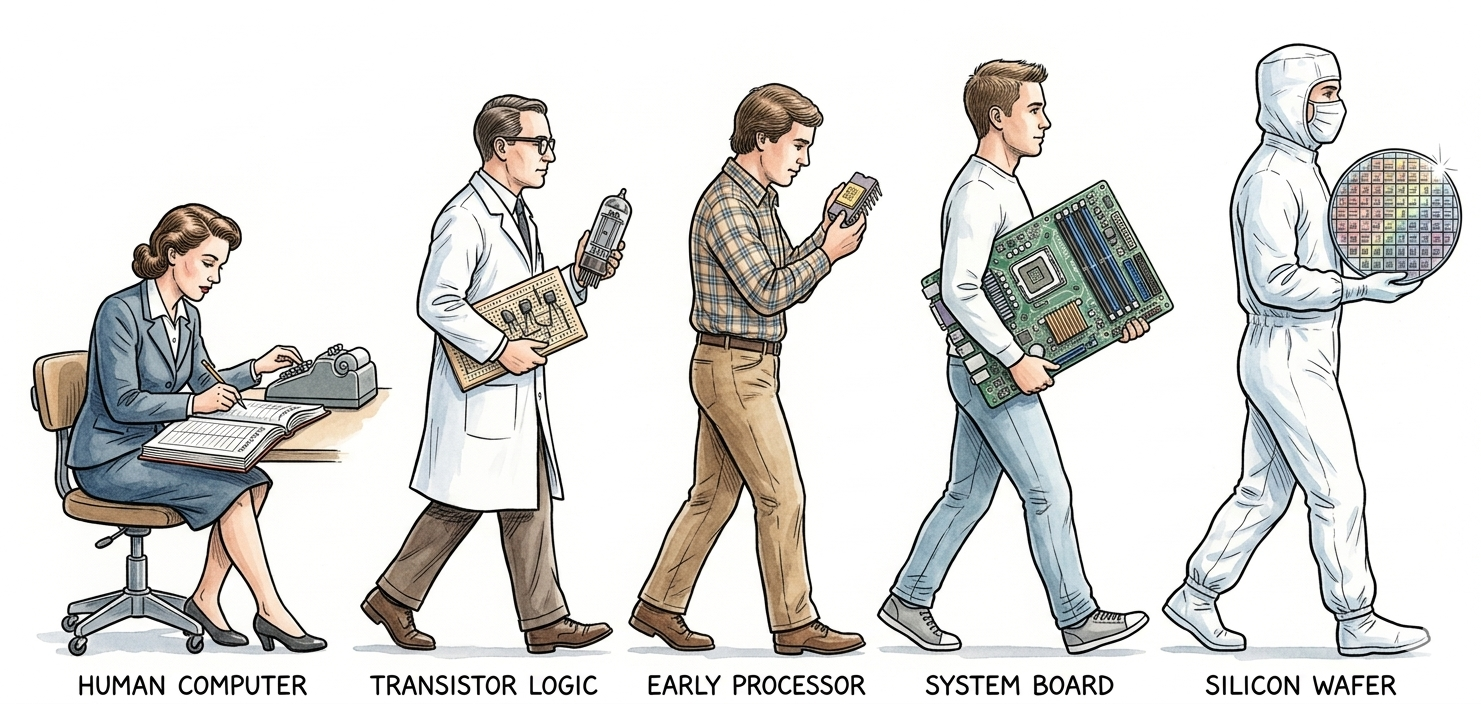
Evolution in Pieces: Processors, Boards, and Silicon
As we moved into the 1970s, the goal was simplification. Engineers were trying to cram more power into smaller spaces.
1. The Early Processor: The Centralized Brain (1971)
The defining moment for personal computing arrived with the Intel 4004 in 1971. This was the world's first microprocessor. Before the 4004, a computer's "brain" was built from thousands of separate transistors and components spread across several large boards. The 4004 changed the game by being the first to put all the essential components—the central processing unit (CPU), memory, and input/output control—onto a single, tiny chip. This small ceramic square, barely larger than a fingernail, centralizing all computational logic, made the first desktop calculators possible and laid the roadmap for the personal computers of the 80s.
2. The System Board: The Great Connector
As processors became standardized and smaller, the challenge became connecting them to memory, storage (like the early HDDs), and user inputs. In the late 70s, companies like Apple (with the Apple II) and later IBM (with the IBM PC) introduced the motherboard or system board. This wasn't just a simple circuit; it was the computer's central nervous system. It provided a standardized, pre-built backbone that allowed different components (CPU, RAM, expansion cards) to plug in and communicate effortlessly. By popularizing this architecture, computer builders no longer had to custom-engineer every connection by hand; they could mass-produce standardized parts, making PCs affordable.
3. The Silicon Wafer: The Canvas of Computing
All this complexity starts with a simple, abundant material: sand. Pure silicon is derived from sand, melted down, and grown into massive, single-crystal cylinders called "ingots." These ingots are sliced into ultra-thin, mirror-smooth discs: silicon wafers. This wafer is the actual physical canvas for building modern chips. Using incredibly precise photolithography (like advanced photography), engineers layer and etch billions of transistors onto a single wafer. After testing, the wafer is cut into individual squares, becoming thousands of distinct processors. The perfection and purity of this wafer are critical; even a speck of dust can destroy thousands of potential chips. Modern chip foundries work in environments cleaner than surgical operating rooms.
The Rise of the Ghost in the Machine: AI
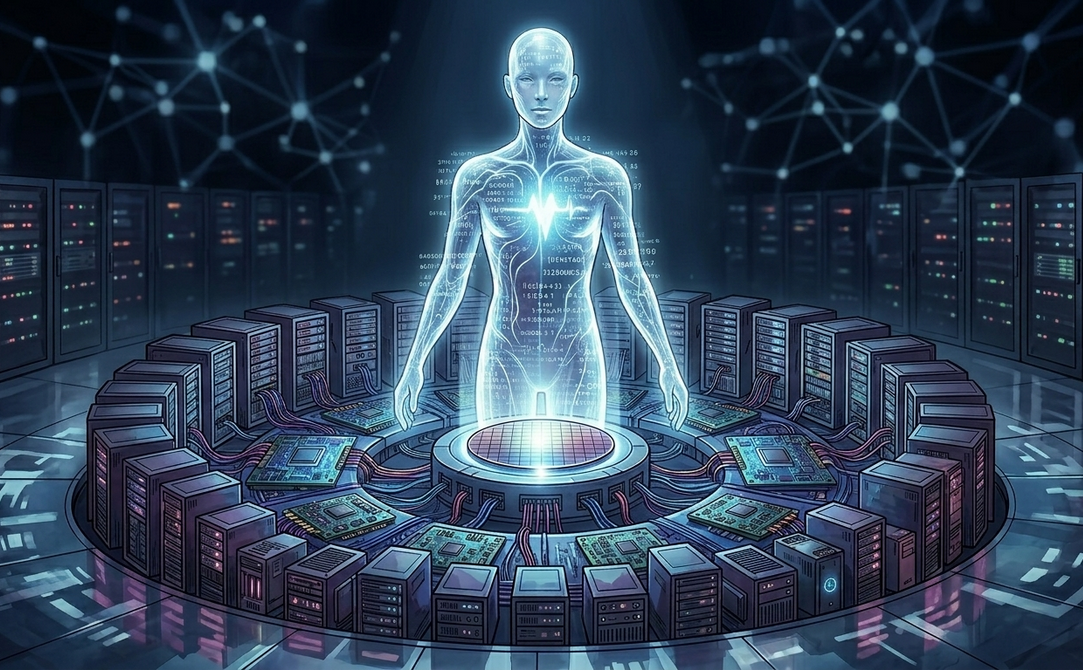
By the 1980s, these advances brought the "Personal Computer" into the home. And as computers got faster, we stopped asking them to just "calculate" and started asking them to "think."
Artificial Intelligence (AI) isn't actually a new idea. It started in the 1950s with a simple question: Can a machine mimic human intelligence? For decades, AI was just "if-then" logic. If you press 'A', the computer does 'B'.
But in the last decade, we hit a turning point called Machine Learning. Instead of us teaching the computer every rule, we gave the computer mountains of data and let it teach itself patterns. This is how we went from simple calculators to AI that can write poetry, diagnose diseases, and drive cars.
The Future: What’s Next?
We are currently hitting the physical limits of how small we can make silicon chips. So, where do we go from here? The future of computing looks less like a "box" and more like science fiction:
Quantum Computing: Imagine a computer that doesn't just calculate one thing at a time, but calculates every possible answer simultaneously. These machines will solve problems in seconds that would take today’s supercomputers 10,000 years.
Invisible Computing: We are moving toward "ambient" tech. This means your "computer" might just be a pair of glasses or a contact lens that overlays data onto the real world (Augmented Reality).
Neural Links: Some scientists are working on direct interfaces between the human brain and computers. The "human computer" of the 1700s might literally merge with the digital computer of the 2000s.
Computing has always been about one thing: extending the reach of the human mind. Whether it was a mathematician in 1850 or a coder in 2026, we’ve always used tools to solve the "unsolvable."
We’ve come a long way from 30-ton machines and sharpened pencils, and the best part? We’re still just getting started.
