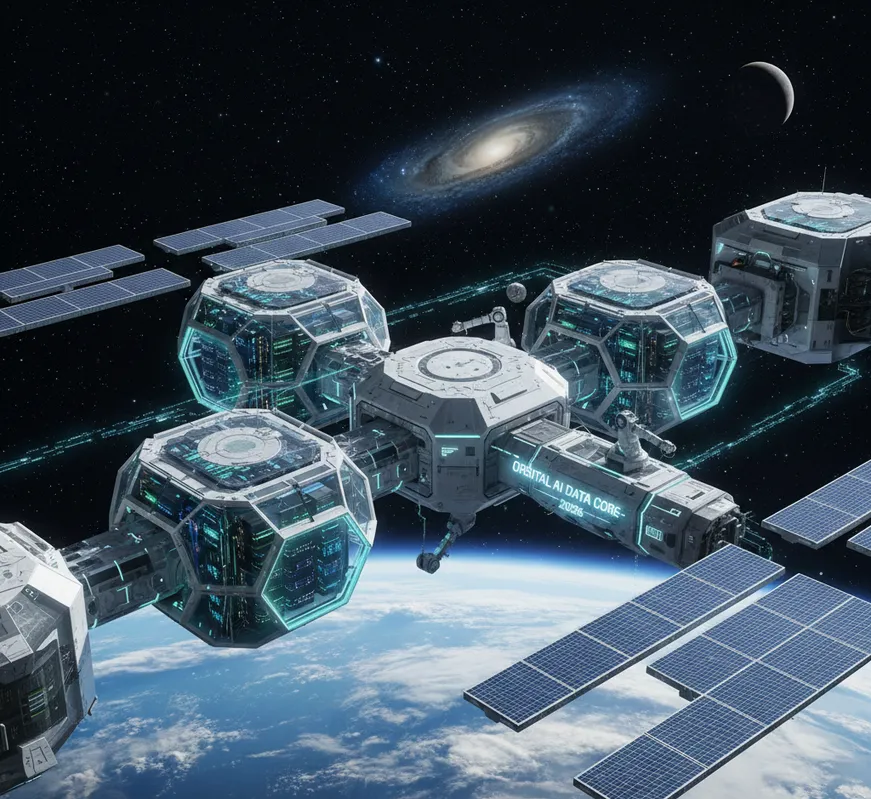
AI MOVES TO SPACE
Why the Future of AI is Moving to Outer Space
If you’ve been following the news lately, you might have heard that Big Tech companies aren't just building data centers in rural Iowa or the deserts of Arizona—they are looking at the stars. As of 2025, "Space Data Centers" have moved from a wild idea to a multi-billion dollar reality.
But why would anyone want to put a computer in orbit? It sounds expensive, risky, and a bit like a plot from a sci-fi movie. Here is the "down to earth" explanation of why the AI revolution is heading into the cosmos.
1. The Power Problem (The Sun Never Sets)
On Earth, data centers are "energy hogs." A single large AI facility can use as much electricity as a small city. This puts a massive strain on our local power grids and raises electricity prices for everyone else.
In space, specifically in certain orbits, the sun never sets. * 24/7 Energy: Satellites can sit in constant sunlight, soaking up solar energy every second of the day.
Pure Power: Without the Earth’s atmosphere (clouds, dust, and air) to block the light, solar panels in space are nearly 8 times more effective than those on your roof.
2. The Heat Problem (The Ultimate Freezer)
If you’ve ever felt your laptop get hot while running too many apps, imagine that times a billion. Data centers generate incredible amounts of heat. On Earth, we use millions of gallons of water or massive air conditioning units to keep them from melting.
Space, however, is naturally freezing. By using specialized "radiators" (which look like giant wings on a satellite), these space computers can dump their heat directly into the cold vacuum of the universe. No water required, and no risk of overheating the local environment.
3. The "Rad-Hard" Challenge: Protecting the Brains
Space is a beautiful place, but it’s also a shooting gallery of invisible radiation. Tiny particles from the sun can hit a computer chip and cause a "bit flip"—essentially making the computer "forget" or hallucinate a piece of information.
To fix this, engineers use Radiation Hardening (or "Rad-Hard"):
Physical Armor: Chips are shielded with materials like lead or specialized glass.
Double-Checking: Many space computers are built in "triplets." Three chips do the same math at the same time; if one gets hit by radiation and gives a different answer, the other two "outvote" it to keep the data accurate.
4. Why should you care?
Moving AI to space isn't just about tech; it’s about Earth’s resources. * Saving Water: We can stop using billions of gallons of drinking water to cool computers.
Green Energy: We stop burning fossil fuels to power AI, using the infinite "green" energy of the sun instead.
Faster Answers: For things like weather tracking, crop monitoring, or disaster response, having the "brain" (the AI) right next to the "eyes" (the satellite cameras) means we get life-saving information much faster.
Who is leading the charge?
Lumen Orbit: Already successfully ran AI tests in space in 2025.
Google's Project Suncatcher: Working on a "constellation" of solar-powered AI satellites.
Axiom Space: Planning to attach a "data hub" to a commercial space station by 2027.
Space data centers are the ultimate "remote office." By moving the heavy lifting of AI off-planet, we make the technology more sustainable and powerful without breaking our own power grids back home.
